Saturday, February 21, 2015

American Presidents by "Wait But Why"

"Wait But Why" has done a fabulous and fun profile of each president up to #25:

Part 1 -- Washington to Lincoln
  • George Washington:  As a “six-star general,” so now he’s the highest-ranking military officer in US history.
  • John Adams:  One of the only pre-Civil War presidents to oppose slavery openly.  Also, founder of the Navy.
  • Thomas Jefferson:  Wrote the Declaration of Independence in his early 30's.  Also, Lewis & Clark; Louisiana Purchase.
  • James Madison:  5'4" and 100#.  War of 1812.
  • James Monroe:  the last of the "Founding Father" presidents.  Monroe Doctrine.
  • John Quincy Adams:  A close vote, he lost both the popular and the electoral vote to Andrew Jackson and only won the presidency because the margin was too narrow and it came down to a Congressional vote
  • Andrew Jackson:  Crazy and tough, "a notorious hothead, bordering on insane, and engaged in over 100 duels in his lifetime."  Indian Removal Act
  • Martin Van Buren:  1st president to be born an American citizen; nicknamed “Van Ruin" because of the 1837 financial crisis which dominated his single term
  • William Henry Harrison:  The only US president to have attended medical school, he died after only a month in office
  • John Tyler:  "His Accidency"  
  • James Polk:  Made the US a huge, coast-to-coast nation (Mexican-American War) in only 1 term
  • Zachary Taylor:  An old war-hero who died after only a year in office (poisoned?), "he never went to school, had no political experience, never voted in his life, and dressed like a farmer"
  • Millard Fillmore:  Taylor's VP who took over; Commodore Perry expedition to Japan
  • Franklin Pierce:  “All that’s left, is to drink and die.”
  • James Buchanan:  2nd to last in Presidential rankings, as the Civil War broke out during his term.  "Historians often cite Buchanan’s ambiguity in the face of secession to be the #1 worst decision by a US president."  Gay, probably.
  • Abraham Lincoln:  #1 President
Part 2 -- Johnson to McKinley
  • Andrew Johnson:  3rd worst President, spent his term “trying to undo all the progress of the Civil War”
  • Ulysses S. Grant:  #1 Civil War hero but unimpressive President with the most corrupt administration ever.  "Most impressive failure of a man ever."  But he passed the 15th Amendment and authored memoirs that Mark Twain considered "a literary masterpiece."
  • Rutherford B. Hayes:  Seems like a good guy -- progressive, war-hero, promoted bi-partisanship and a merit system.  Handsome when he was younger!
  • James A. Garfield:  Assassinated after less than 3 months in office.
  • Chester Arthur:  More effective than expected.
  • Grover Cleveland:  #22 and 24.  The only Democrat to be elected president during an otherwise completely Republican-dominated half century.
  • Benjamin Harrison:  Grandson of William Henry Harrison (#9 above).  Passed the Sherman Antitrust Act and was "more serious about rights for African Americans than any president before him."
  • William McKinley:  Spanish-American War (to support Cuba's demand for independence).  Assassinated and succeeded by VP Theodore Roosevelt.

Simon Schama's Power of Art

This week, I've watched all 8 episodes of the BBC's wonderful series on Simon Schama's "Power of Art."
  1. Caravaggio – David with the Head of Goliath (c. 1610)
  2. Bernini – Ecstasy of Saint Teresa (1657)
  3. Rembrandt – The Conspiracy of Claudius Civilis (1662)
  4. David – The Death of Marat (1793)
  5. Turner – The Slave Ship (1840)
  6. Van Gogh – Wheatfield with Crows (1890)
  7. Picasso – Guernica (1937)
  8. Rothko – Black on Maroon (1958)

Tuesday, February 17, 2015

Khan Academy Art History

A great lesson contrasting the Kouros with Doryphorus to examine contrapposto.  The whole series is amazing, a great resource for future teaching.


Saturday, February 14, 2015

Readings for "Configuring the World: A Critical Political Economy Approach"

Week 0

Extra Readings

  • Cox, R.W. and Schechter, M.G. (2002). 'The political economy of a plural world: critical reflections on power, morals and civilization'. Psychology Press.Click here to read
  • Frieden, J., & Martin, L. L. (2002) 'International political economy: Global and domestic interactions” in I. Katznelson and H.V.Milner (eds) Political Science: The State of the Discipline, New York, 118–46. Click here to read
  • Mayer, T. (2006). 'The empirical significance of econometric models', University of California- Department of Economics. Working Paper. no. 06.20 Click here to read
  • Murphy, C. N., & Nelson, D. R. (2001) “International political economy: a tale of two heterodoxies” The British Journal of Politics & International Relations, 3, 3, 393-412 (earlier version of same article) Click here to read
  • Musco,V. (1996) “What is Political Economy? Definitions and Characteristics” in V. Musco, The Political Economy of Communication: Rethinking and Renewal , Sage, 21-36. Click here to read
  • Payne, A. (2006). 'Key Debates in New Political Economy', Routledge. Click here to read

Week 1

Required Readings

  • Richard Griffiths, 'Readings Week One – Part 1: Population and GDP Current Values'  Click here to read
  • Richard Griffiths, 'Readings Week One – Part 2: GDP ppp and Poverty' Click here to read

Extra Readings

  • Anderson, B. (1989) “Imagined Communities” from B. Anderson, Imagined Communities: Reflections on the Origin and Spread of Nationalism, London, 48-59. Click here to read
  • Costanza, R., Hart, M., Posner, S. and Talberth, J. (2009). "Beyond GDP: The Need for New Measures of Progress", Boston. Click here to read
  • Haggard, B. (2000). "The Gross Domestic Product and Alternative Economic and Social Indicators". Parliamentary Research Branch, London. Click here to read
  • Harley, J.B (1987) “The Map and the Development of the History of Cartography”, in J.B. Harley and D. Woodward, History of Cartography, Chicago Volume 1, 1-42. Click here to read 
  • Kirk, D. (1996) “Demographic Transition Theory”, Population Studies, 50, 1996, 361-387. Click here to read
  • Population Institute (2011)."From 6 Billion to 7 Billion. How population growth is changing and challenging our world". Click here to read
  • Stanton, E.A. (2007). "The Human Development Index: A History" PERI Working Paper, 127. Click here to read
  • Sagara, A.D and Najamb , A. (1998) “The human development index: a critical review” Ecological Economics,25,  3, 249–264. (Don’t forget that the Index has mutated since this was written - RTG). Click here to download the article

Database

Transcript of the lectures

  • PDF transcripts of the lectures including pictures and screenshots provided by our own CtW student, Sandy Landoll: Week 1


Week 2

Required Readings

Extra Readings

  • Bowles, S. and  Gintis, H. (2002) “Social Capital and Community Governance” The Economic Journal, 112, 483, 419-436. Click here to read
  • Grootaert, C.and van Bastelaer, T (2001). "Understanding and Measuring Social Capital: A Synthesis of Findings and Recommendations from The Social Capital Initiative". Social Capital Initiative Working Paper No. 24. Click here to read 
  • Guinnane, T.W. (2006). "Trust: A Concept Too Many". Yale Economic Growth Center Discussion Paper 907. Click here to read
  • Keefer, P. and  Knack, S. (2008) “Social Capital, Social Norms and the New Institutional Economics” In M.M. Shirley and C. Ménard (eds) Handbook of new institutional economics, Berlin Heidelberg, 701-725. Click here to read
  • McKnight, D. H. and Chervany, N. L. (2001). “Trust and distrust definitions: One bite at a time” In R.F.M. Singh and Y.H. Tan (eds) Trust in Cyber-societies. Berlin Heidelberg, 27-54. Click here to read
  • Putnam, R. (2001) “Social Capital: Measurement and Consequences” Canadian Journal of Policy Research, 2, 1, 41-51.Click here to read
  • Siisiäinen, M (2000). "Two Concepts of Social Capital: Bourdieu vs. Putnam". Paper presented at ISTR Fourth International Conference, Dublin, Ireland, July 5-8, 2000. Click here to read
  • Woolcock, M. and Narayan, D. (2000) “Social Capital: Implications for Development Theory, Research, and Policy” World Bank Research Observer, 15, 2, 225-249. Click here to read
Database

Transcripts of the lecture

  • PDF transcripts of the lectures including pictures and screenshots provided by our own CtW student, Sandy Landoll: Week 2


Week 3

Required Readings

Extra Readings

  • Alesina, A., Devleeschauwer, A., Easterly, W., Kurlat, S. and  Wacziarg, R. (2003) “Fractionalization” Journal of Economic Growth, 8(2), 155-194. Click here to read
  • Atkinson, A.B., Piketty, T. and Saez, E. (2011) “Top Incomes in the Long Run of History” Journal of Economic Literature, 49, 1, 3–71. Click here to read
  • Easterly, W. and Levine, R. (1997)“Africa's Growth Tragedy: Policies and Ethnic Divisions” The Quarterly Journal of Economics, 1203-1250. Click here to read
  • Lambart, K. (2010) What is hidden behind the indicators of ethnolinguistic fragmentation?  FERDI, (No. I07).Click here to read
  • Montalvo, J. and Reynal-Querol, M. (2002). "The Effect of Ethnic and Religious Conflict on Growth" PRPES Working Paper, No 15. Click here to read
  • OECD (2011) “An Overview of Growing Income Inequalities in OECD Countries: Main Findings” in OECD, Divided We Stand Why Inequality Keeps Rising, Paris. Click here to read
  • Posner, D. N. (2004) “Measuring ethnic fractionalization in Africa” American Journal of Political Science, 48, 4, 849-863. Click here to read
  • Simic, S. (2012) A critical reading of ‘The Spirit Level: why equality is better for everyone’, R. Wilkinson and K. Pickett. What is the scientific content of the book? CERES. Click here to read
  • Wade, R.W. (2014) “The Piketty Phenomenon and the Future of Inequality” Real World Economics Review, 69, 2-17.Click here to read

Database

Transcripts of the lecture

  • PDF transcripts of the lectures including pictures and screenshots provided by our own CtW student, Sandy Landoll: Week 3

Week 4

Required Readings

  • Arndt, Christiane and Oman, Charles. "The politics of governance ratings." Maastricht Graduate School of Governance, 1998. Click here to read

Extra Readings

  • Arndt, C. and Oman, C. (2006). "Uses and Abuses of Governance Indicators, OECD". Paris. Click here to read
  • Cooper Drury, A., Krieckhaus, J. and Lusztig, M. (2006) “Corruption, Democracy, and Economic Growth” International Political Science Review, 27, 2,  121-136. Click here to read
  • Fukuyama, F. (2013). "What is Governance? Center for Global Development", Working Paper 314. Click here to read
  • Gerring, J., Bond, P. Barndt, W.T. and Carola Moreno, C. (2005). “Democracy and Economic Growth. A Historical Perspective” World Politics, 57, 323–364.Click here to read
  • Kaufmann, D., Kraay, A. and Mastruzzi, M. (2010). "The Worldwide Governance Indicators". Methodology and Analytical Issues, World Bank Policy Research Working Paper 5430. Click here to read
  • Erickson, M.M. (ed) (2007). "Research on Corruption and Its Control The State of the Art", Washington. Click here to read
  • Tanzi, V. (1998). "Corruption around the World. Causes, Consequences, Scope and Cures", IMF Working Paper 98/63. Click here to read
  • M.A. Thomas, M.A. (2010) “What Do the Worldwide Governance Indicators Measure?” European Journal of Development Research, 22, 1, 31–54. Click here to read
  • UN, DESA, (2007). "Public Governance Indicators: A Literature Review", New York. Click here to read

Database

Transcripts of the lecture

  • PDF transcripts of the lectures including pictures and screenshots provided by our own CtW student, Sandy Landoll: Week 4


Week 5

Required Readings

  • Hjertholm, Peter and White, Howard. "Survey of Foreign Aid: History, Trends and Allocation". Institute of Economics University of Copenhagen, 2000. Pages 3-36 and 45-54. Click here to read

Extra Readings

  • Acemoglu, D., Robinson, J.A. and Woren, D. (2012). "Why Nations Fail: The Origins of Power, Prosperity, and Poverty", New York.Click here to read 
  • Alesina, A. and Dollar, D. (1998) “Who Gives Foreign Aid to Whom and Why?” NBER Working Paper 6612. Click here to read
  • Arndt, C., Jones, S. and Tarp, F. (2011). "Aid Effectiveness: Opening the Black Box",  World Institute for Development Economics Research Working paper 44. Click here to read
  • Easterly, W. and Tobias Pfutze, T. (2008) “Where Does the Money Go? Best and Worst Practices in Foreign Aid” Journal of Economic Perspectives, 22, 2.Click here to read
  • Gates, S and Hoeffler A. (2004). "Global Aid Allocation: Are Nordic Donors Different?" CSAE Working Paper 2004-34. Click here to read
  • Kharas, H. (2007). "Trends and Issues in Development Aid", Wolfenson Center for Development Working Paper No 1. Click here to read
  • Rotberg, R.I. (2010) “Failed States, Collapsed States, Weak States: Causes and Indicators” in R.I Rotberg, When States Fail: Causes and Consequences, 1-25. Click here to read
  • Tingley, D. (2010) “Donors and domestic politics: Political influences on foreign aid effort”, The Quarterly Review of Economics and Finance 50 (2010) 40–49. Click here to read
  • Torres, M.M. and Anderson, M (2004). "Fragile States: Defining Difficult Environments for Poverty Reduction", PRDE Working Paper 1. Click here to read

Database

Transcripts of the lecture

  • PDF transcripts of the lectures including pictures and screenshots provided by our own CtW student, Sandy Landoll: Week 5


Week 6

No Required Readings

Extra Readings

  • Berry, C. (2008). "International political economy, the globalisation debate and the analysis of globalisation discourse". University of Warwick. Centre for the Study of Globalisation and Regionalisation, Working Paper No 247. Click here to read
  • Buethe, T. and Milner, H.V. (2008) “The Politics of Foreign Direct Investment into Developing Countries: Increasing FDI through International Trade Agreements?” American Journal of Political Science, 52, 4, 741–762.Click here to read
  • Contessi, S. and Weinberger. A. (2009) “Foreign Direct Investment, Productivity, and Country Growth: An Overview” Federal Reserve Bank of St. Louis Review, 91, 2, 61-78. Click here to read
  • Eichengreen, B. and James, H. (2003) “Monetary and Financial Reform in Two Eras of Globalization” M.D. Bordo, A.M. Taylor, and J.G. Williamson (eds)Globalization in Historical Perspective, Chicago. Click here to read
  • Kiely, R. (2005). "The Clash of Globalisations. Neo-Liberalism", the Third Way and Anti-Globalisation, Leiden, Boston. Click here to read
  • Levi, M.D. (2005) 'International Finance', London, New York. Click here to read
  • Lipsey, R.E. (2009) “Measuring International Trade in Services” in M. Reinsdorf and M. J. Slaughter, International Trade in Services and Intangibles in the Era of Globalization, 27-70. Click here to read
  • Love, P. and  Lattimore, R. (2009). "International Trade Free, Fair and Open?: Free, Fair and Open?" OECD, Paris. Click here to read
  • Sen, S. (2005) “International Trade Theory and Policy: What Is Left of the Free Trade Paradigm?” Development and Change 36, 6, 1011–29. Click here to read
  • Robert C. Shelburne (2010)."The Global Financial Crisis and its Impact on Trade: The World and the European Emerging Economies", UN, ECE Discussion Paper. Click here to read
  • Tomz, M. (2002) “International Finance”, W. Carlsnaes, T. Risse, and B.A. Simmons, (eds.) Handbook of International Relations, 692-719. Click here to read

Database

Transcripts of the lecture

  • PDF transcripts of the lectures including pictures and screenshots provided by our own CtW student, Sandy Landoll: Week 6


Week 7

Required Readings

  • Mearsheimer, John J. "The False Promise of International Institutions," International Security, Vol. 19, No. 3 (Winter 1994/1995), pp. 5-49. Click here to read

Extra Readings

  • Bordo, M.D. (1993) “The Bretton Woods International Monetary System: A Historical Overview” M.D. Bordo and B. Eichengreen (eds.) A Retrospective  on the Bretton Woods System: Lessons for International Monetary Reform, 3-108.Click here to read
  • Brown, C.D. (2009) The WTO and GATT: A Principled History Brookings. Click here to read 
  • Boughton, J.M.  (2004) The IMF and the Force of History, Ten Events and Ten Ideas that have Shaped the Institution, IMF Working Paper 04/75. Click here to read
  • Grasstek, C van (2013). "The History and Future of the World Trade Organization", Geneva. Click here to read
  • Irwin, D,A. (1995) “The GATT in Historical Perspective” The American Economic Review, 323-328. Click here to read
  • Jönsson, C. and  Tallberg, G. (2011) “Institutional Theory in International  Relations” G. Peters, J. Pierre and G. Stoker (eds) Institutional Theory in Political Scienec. The New Institutionalism. Click here to read
  • Katzenstein, P.J., Keohane, R.O. and Krasner, S.D. (1998) “International Organization and the Study of World Politics” International Organization, 645-685.Click here to read
  • Keohane, R.O. (1998) “International Institutions: Can interdependence work?” Foreign Policy, 110, 82-96. Click here to read
  • Simmons, B.A. and Martin, L.L. (2001) “International Organizations and Institutions” in W. Carlness, T. Risse and B.A. Simmons, Handbook of International Relations, 192-211. Click here to read

Transcripts of the lecture

  • PDF transcripts of the lectures including pictures and screenshots provided by our own CtW student, Sandy Landoll: Week 7


    Week 8

    Extra Readings (will not appear in the final exam)

    • Corporate Europe Observatory (2014). "The Record of a Captive Commission. The ‘black book’ on the corporate agenda of the Barroso Commission".Click here to read
    • Drutman, L. (2011). "The Business of America is Lobbying. Explaining the growth of corporate political activity in Washington DC". Working Paper, 2010.Click here to read
    • Heemskerk, E.M., Daolio, F. and Tomassini, M. (2013) “The Community Structure of the European Network of Overlapping Directorates” Plos one, 10, 1371. Click here to read
    • Keck, Margaret E., and Kathryn Sikkink. "Transnational advocacy networks in international and regional politics." International Social Science Journal 51, no. 159 (1999): 89-101. Click here to read
    • Porter, M.E. (2008) “Five Competitive Forces that Shape Strategy” Harvard Business Review. Click here to read
    • Sassen, S. (2005) “The Global City. Introducing a Concept” Brown Journal of World Affairs, 9, 2, 27-43. Click here to read
    • Urban world: Mapping the economic power of cities. McKinsey Global Institute, 2011. Click here to read
    • Vitali, Stefania, James B. Glattfelder, and Stefano Battiston. "The network of global corporate control." PloS one 6.10 (2011): e25995Click here to read

    Transcripts of the lecture

    • PDF transcripts of the lectures including pictures and screenshots provided by our own CtW student, Sandy Landoll: Week 8

    Friday, February 13, 2015

    MAPS!

    BBC Four series on "The Beauty of Maps"

    Library of Congress exhibit

    Curiosities:  Maps That Will Change the Way You See the World

    a very different approach in mapping social data based on population rather than land area: http://www.worldmapper.org/

    Asia in the middle: http://www.wsfly.com/Resources/Uploads/Images/world201401.jpg
    America in the middle: https://stephenliddell.files.wordpress.com/2012/09/world-map.gif
    Europe in the middle: http://www.h3dwallpapers.com/wp-content/uploads/2014/09/Map_of_the_world-12.gif

    UPSIDE DOWN

    a tumblr all about amazing maps for anyone ho REALLY like maps :) Beware, hours of your life may disapear:  http://mapsdesign.tumblr.com/

    http://www.viewsoftheworld.net

    Criticisms of the Mercator Projection from "The West Wing"


    10 Beautiful Medieval Maps

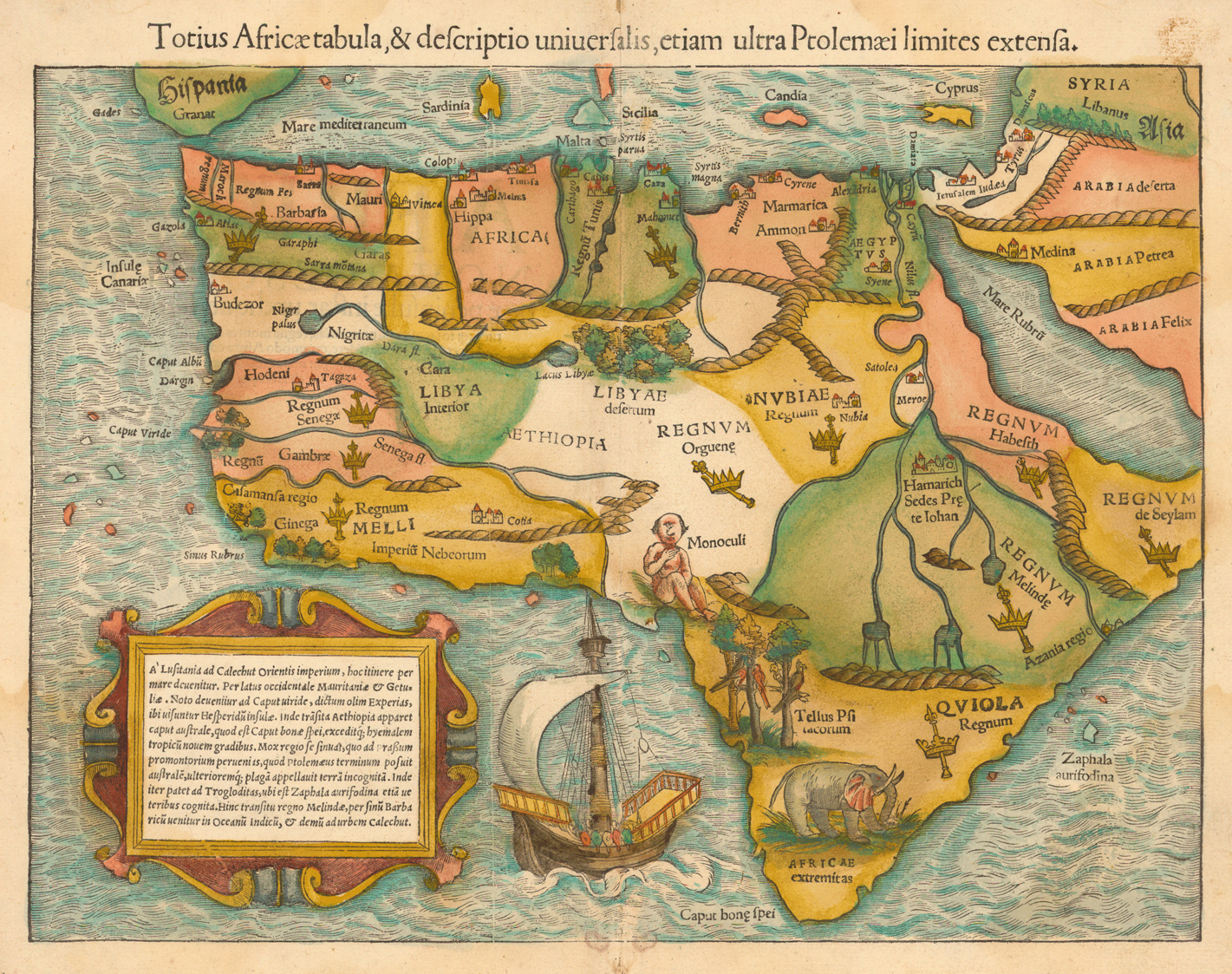
    Here the first map of the whole continent of Africa, drawn in 1552 by Sebastian Münster. He was a professor of Hebrew at Heidelberg and later in Basel where he died of the plague in 1552. Münster was the most influential cartographer in the mid 16th century. This map indicates many interesting things, like the one-eyed giant in Nigeria and Cameroon or the elephant who is placed in southern Africa. 
    http://libweb5.princeton.edu/visual_materials/maps/websites/africa/maps-continent/1554munster.jpg
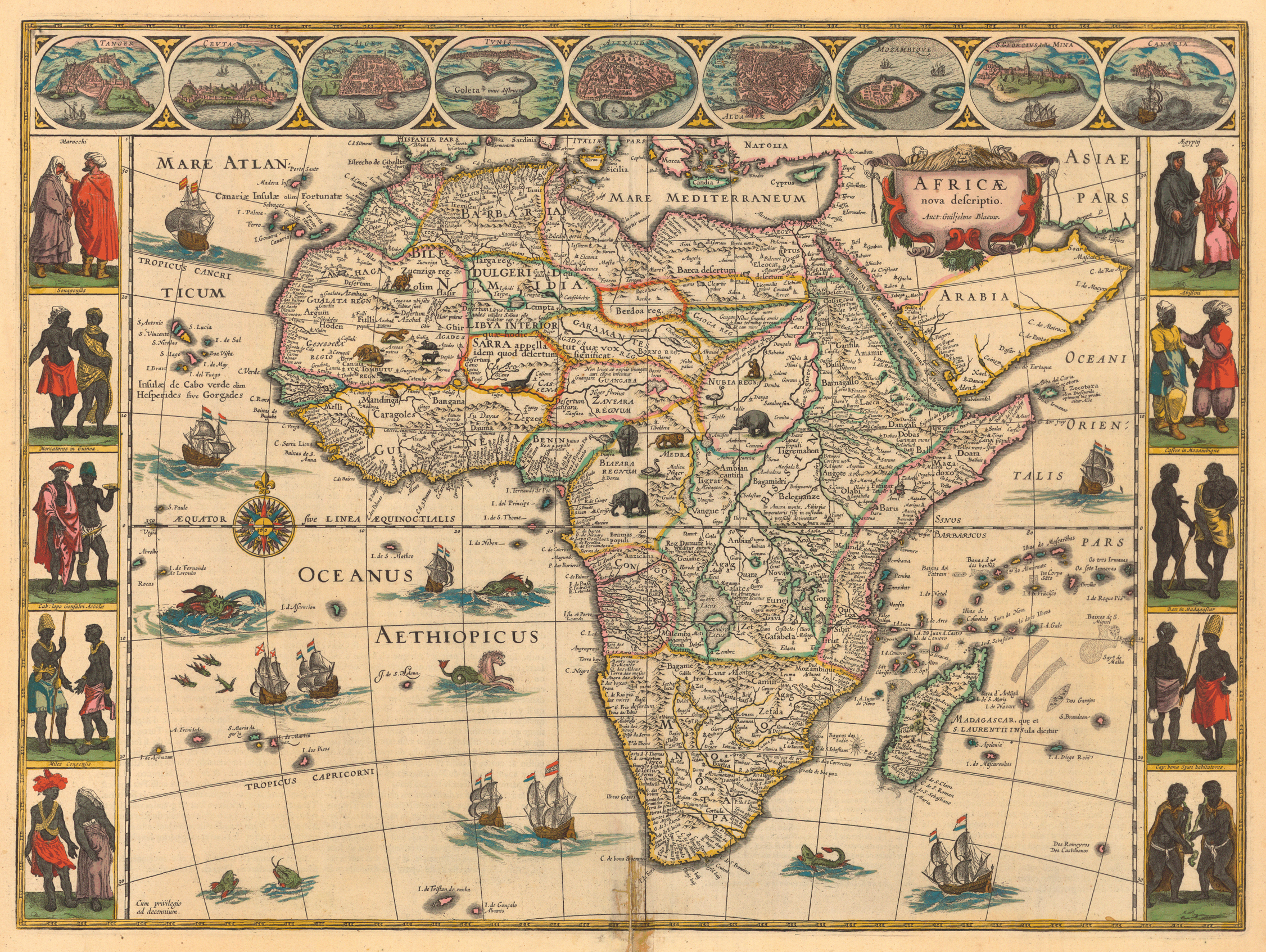
    And just a few years later, 1584, Abraham Ortelius (Belgium) showed another map which is very different as the other one: Africa assumes a more recognizable shape, Madagascar appears. The map indicates no animal or plant except in the water the swordfish and the whale. http://libweb5.princeton.edu/visual_materials/maps/websites/africa/maps-continent/1644%20blaeu.jpg 

    Information Literacy Tutorials: Watch, Do, Read

    https://d396qusza40orc.cloudfront.net/configuringworld/TAB%20SOURCES%20FINAL.pdf

    Provides three links -- watch, do, and read -- for each of the following information literacy topics:

    Wednesday, February 11, 2015

    Google: "Authority and credibility of sources on the web"


    5:35 -- What students are told in HS, "a lot of negativity" around internet sources (like Wikipedia)
    7:15 -- Difference between "credibility," "authoritative," "informative," and "useful"
    8:50 -- What is spam?
    12:20 -- Rules of thumb for credibility
    25:50 -- Predict before you click, [different breeds of cat] example
    34:00 -- [immigrants sending money home] example of how official terms lead to official results
    37:00 -- verbatim search mode for unenhanced results
    48:25 -- Wikipedia as a "stepping stone" resource
    51:20 -- Common misconceptions
    53:15 -- Google custom search engine (google.com/cse) is a cool way to set up for students a preselected set of sources, in which you can use Google search tools.
    53:50 -- .edu and .org does not necessarily indicate better quality
    54:45 -- there are no "good sources" and "bad sources" just sources better/worse suited for different needs
    55:30 -- tech tools you can use to check authority, like Alexa.com
    58:25 -- ways to look for plagiarism


    From a different Google presenter:
    2;35 -- Related to authority:  credibility, informative, useful
    4:40 -- Authority = "official information" or "formal recognition"
    5:50 -- Teach students to be skeptical
    7:50 -- Recognizing point of view:  ufos-aliens.co.uk vs. NASA
    11:05 -- Why the Yeti King Crab site is not trustworthy (spelling, no citations, no about us)
    19:40 -- not all .edu sites are authoritative
    23:15 -- some top-level domains don't really mean anything in terms of authority (.com, .org, etc.)
    31:00 -- the whois tool: [whois martinlutherking.org] owned by a white supremacist
    35:35 -- using the link: operator to see who links to mayoclinic.com and ufos-aliens.co.uk
    A great short summary at the end, too, starting around 43:40.