Wikipedia timeline based largely on events described by the book.
Key Events in the 1953 Coup, a great timeline by the NY Times

Chapter 1: Good Evening, Mr. Roosevelt.
The first half of this chapter includes a good overview/background of the situation leading up to the coup, how the British stoked US fears of communism to provoke the CIA to go along with plans to overthrow PM Mossadegh, who threatened their economic/oil interests. The second part details Kermit Roosevelt's orchestration of events leading in Operation Ajax in August 1953, and how it initially failed as the Mossadegh was alerted to the threat and Shah Mohammed Reza Pahlavi fled.

Chapter 2: Curse This Fate. Great chapter on the history of Iran. Explains the origins and meanings of Shia (Persian) Islam better than just about anything I've read, putting the pieces together in describing Ali, his son Hussein, Shah Ismail, etc. and then the disarray that Iran fell into under the Qajar Dynasty (late 1700s to 1925).

Chapter 3: The Last Drop of the Nation's Blood. Details Iran's early moves toward democracy with the Tobacco Revolt (beginning of Iranian nationalism) against Nasir al-Din Shah; followed by his son Muzzaffar, whose profligate ways (and the Knox D'Arcy concession) led to a revolution to form Persia's first constitution in 1906, which was eventually aborted. Shah Mohammad Ali's efforts against the new constitution, and his son Ahmad's going over the head of the Majlis to award the British in 1920's harsh Anglo-Persian Agreement. All of these terrible Qajar rulers eventually led to the rise of Reza Khan Pahlavi in the 1920's, whose heavy-handed attempts to modernize Iran failed.
 |
| Mossadegh as "Man of the Year" in 1952 |
Chapter 5: His Master's Orders. This chapter details the 3-way political tug-of-war over the British-proposed Supplemental Agreement in 1949 intended to appease Iran:
- pushed by the playboy son of Reza Shah, Mohammed Reza Pahlavi
- opposed by Mossadegh and his coalition, which included support from religious leaders like Ayatollah Abolqasem Kashani (anti-British, nationalist, Islamist)
- General Ali Razmara elected PM in 1950, who took a compromise position until he was assassinated. (By refusing to compromise at all, the British didn't help him.)
- "Razmara took office convinced that destiny had chosen him to lead Iran back to greatness. Mossadegh believed the same about himself. So did the Shah. Only one of the three could emerge victorious from the coming confrontation."
- Mossadegh wins, appointed PM in 1951 on a wave of nationalism and resistance to British interference.
- Gen. H. Norman Schwarzkopf, sent to Iran in 1940s to form a police force. - Tudeh communist party in Iran, which prompted a brief independence of the Azerbaijan People's Republic.
- Abadan riots, caused by unequal conditions described vividly on pp. 67-68.
- The Shah's late-1949 visit to the U.S. where he was feted publicly, but behind the scenes resisted advice about social reform and insisted on military aid above all.
Chapter 6: Unseen Enemies Everywhere. This chapter is about American reactions and involvement in the Britain-Iran conflict over nationalization of AIOC. The Truman administration tended to side with Iran on principle (nationalism, sovereignty), appalled by the conditions for Iranian workers at Abadan. Americans considered both the AIOC and British Ambassador Sir Francis Shepherd to be "reactionary and outmoded" in their imperialist policies. The British position was particularly hypocritical: opposing Iranian nationalization at the exact same time they were nationalizing industries at home! However, the U.S. had to be careful not to alienate Britain as their most important NATO ally against communism. Both sides were frustrating to the Americans who tried to forge a way forward.
The title comes from a meeting between State Dept. official George McGee and the Shah, who was paranoid and despondent. Mossadegh does not come across well in this chapter; presented in a NY Times quote as a weird, "redoubtable demagogue" (92). He scoffed at a letter from President Truman offering to send Averell Harriman as his representative for mediation.
Chapter 7: You Do Not Know How Evil They Are. This chapter's title quotes Mossadegh's response to Americans who try to convince him to compromise with the British. The chapter begins with Harriman's tumultuous arrival in Tehran during riots and protests. It ends with Mossadegh winning the opportunity to present his case before the UN Security Council. In between, Harriman's attempts to mediate failed: he got nowhere with Mossadegh and Ayatollah Kashani threatened him personally. The British stoked the crisis further by imposing, embargo and threatening invasion, sending Robin Zaehner to orchestrate opposition to Mossadegh, and undermine Iranian ability to operate their own oil industry.
Chapter 8: An Immensely Shrewd Old Man. Describes Mossadegh's arrival in the U.S. (where he was a huge hit), his appearance before the U.N.:
“My countrymen lack the bare necessities of existence…Our greatest natural asset is oil. This should be the source of work and food for the population of Iran. Its exploitation should properly be our national industry, and the revenue from it should go to improve our conditions of life. As now organized, however, the petroleum industry has contributed practically nothing to the well-being of the people or to the technical progress or industrial development of my country…if we are to tolerate a situation in which the Iranian plays the part of a mere manual worker in the oil fields…and if foreign exploiters continue to appropriate practically all of the income, then our people will remain forever in a state of poverty and misery. These are the reasons that have prompted the Iranian parliament… to vote unanimously in favor of nationalizing the oil industry.”Mossadegh was enormously popular in the U.S. (Iran's George Washington), but the Truman administration's attempts to broker a compromise came to nothing. Mossadegh ridiculed the British for trying “to persuade world opinion that the lamb has devoured the wolf.”And with the no-holds-barred Churchill being elected to replace the Atlee, Britain was about to become more dangerous.
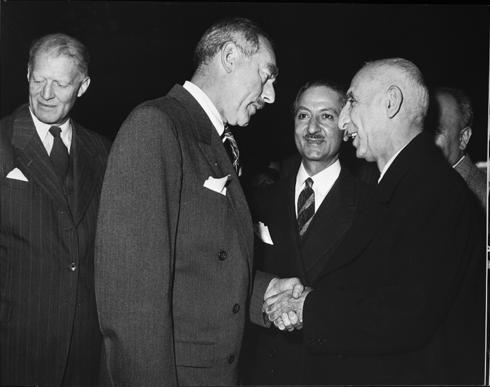 |
| Britain's Prime Minister Mohammad Mossadegh of Iran shaking hands with Sr. Gladwyn Jebb at the United Nations Security Council in New York City |
Chapter 10: Pull Up Your Socks and Get Going. The title references a quote by CIA Directed Walter Bedell Smith telling Kermit Roosevelt shortly after Eisenhower's inauguration: "You won’t have any trouble in London. They’ll jump at anything we propose. And I’m sure you can come up with something sensible enough for Foster to OK. Ike will agree." This chapter is about the U.S. planning.
Mainly focuses on efforts of the Dulles brothers, Foster (Secretary of State) and Alan (CIA), in getting Eisenhower to act and planning Operation Ajax as the expelled British turned over the reins to their American counterparts. CIA agent Donald Wilber worked up a plan. Meanwhile, the Rashidian brothers stirred up opposition to Mossadegh as British agents and pushed Iran toward chaos by kidnapping and murdering government officials (like Tehran police chief General Afshartus).
Chapter 11: I Knew It! They Love Me! This chapter begins by circling back to the end of chapter 1, with the failed coup attempt on August 15-16, and how Kermit Roosevelt improvises a Plan B on the fly and eventually installs Zahedi as the new PM. Mossadegh turns himself in, and the Shah returns from Rome. The title references what the Shah said when he found out that the coup had worked after all. One thing I found interesting is the paragraph at the bottom of p. 179 about why the Soviets didn't intervene to save Mossadegh:
"Stalin had died a few months earlier and the Kremlin was in turmoil. Soviet intelligence officers who would normally be concentrating on Iran were preoccupied with the more urgent challenge of staying alive. Whether any of them even considered trying to defend Mossadegh is among the remaining mysteries of Operation Ajax. Scholars have sought access to records in Moscow that might resolve it, but their requests have been denied."Chapter 12: Purring Like a Giant Cat. Describes the aftermath of the coup, what happened for Mossadegh and his supporters, how the Shah became increasingly oppressive (see Nasiri's fate), until things eventually turned against him in the 1979 revolution. Was the coup worth it? Traces a line between the coup --> hatred for the Shah --> Carter allowing the Shah to come to the U.S. --> Tehran hostages --> U.S. support for Saddam Hussein vs. Iran --> rise of Hamas and Hezbollah --> 1983 deaths of U.S. marines in Beirut --> 1996 attack on U.S. marines in Saudi Arabia --> 1994 bombing of Jewish center in Buenos Aires --> rise of the Taliban --> Osama bin Laden -- > September 11 attacks. "A lot of history ... flowed from a single week in Tehran."
The title comes from a description of a very self-satisfied John Foster Dulles's reaction to news of the coup's success.
Raises lots of interesting questions: What might have happened if the coup hadn't been attempted? Would Iran have fallen prey to communism? How much blame does Mossadegh bear? How did the Dulles brothers make the coup inevitable? Why did Operation Ajax succeed? How might it have played out differently? How have historians characterized these events?
Chapter 13: Epilogue. This chapter tells interesting anecdotes about the author's trip to Iran, his treatment, interviews with villagers in Ahmed Abad where Mossadegh lived the last years of his life under house arrest, meetings with Mossadegh's relatives, how Iranians view Mossadegh today. (Alternate: a similar journey described by a different journalist in Smithsonian Magazine, 2005.)

This comment has been removed by the author.
ReplyDeleteSource: https://docplayer.net/56658282-All-the-shah-s-men-an-american-coup-and-the-roots-of-middle-east-terror-stephen-kinzer-john-wiley-sons-inc.html
ReplyDelete