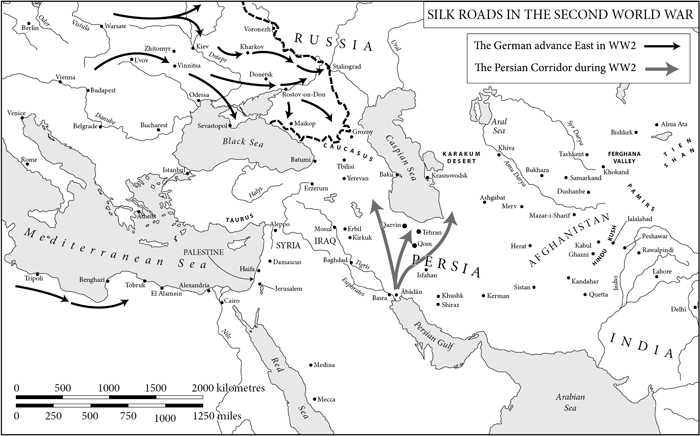
Chapter 19: The Wheat Road. This is a really interesting chapter that asserts a primary Nazi motivation for eastward expansion: control of the Ukrainian and southern Russia's southern "surplus zone" for grain/food. The war in western Europe was a sideshow to the real aims, Frankopan asserts.
Surprisingly in August 1939, Stalin and Hitler had agreed to a non-aggression pact to allow each side to further their interests -- Stalin wanted time to rebuild after famine and self-destructive purges; Germany wanted Poland and resources to the east: "Talking to a senior diplomat in Danzig in August 1939, Hitler brought up the topic of the impossible strain that had been placed on Germany during the First World War – one of his long-term recurring themes. Now, however, he claimed to have the answer. We need Ukraine, ‘so that no one is able to starve us again as they did in the last war’.32"
Meanwhile, Britain panicked about this as a threat to India and interests in the Middle East, where Germans had been expanding activities in the 1930's. Germany was welcomed by fellow anti-Semites in the region, says Frankopan. Admiration of Hitler is tied to Persia's renaming itself as Iran and to the rise of the Ba'ath party in Iraq.
But eventually, feeling overly dependent on their agreement with the Soviets, Germany invaded the Soviet Union with Operation Barbarossa in June 1941. The goal was to enact Herbert Backe's Hunger Plan:
As he stressed to Hitler, Ukraine was the key: control of the rich agricultural plains that ran across the north of the Black Sea and on past the Caspian would ‘liberate us from every economic pressure’.65 Germany would be ‘invincible’ if it could take the parts of the Soviet Union that held ‘immense riches’.66 Gone would be the dependence on the USSR’s goodwill and its whimsical leadership; the effects of the British blockade of the Mediterranean and the North Sea would be massively reduced. This was the chance to provide Germany with access to all the resources it needed.Hitler called these lands "our India" and "our very own Garden of Eden." Goebbels said "the war had been started for ‘grain and bread, for a well-stocked breakfast, lunch and dinner table’. This, and nothing more, was Germany’s war aim, he went on: the capture of ‘the vast fields of the east [which] sway with golden wheat, enough – more than enough – to nourish our people and all of Europe’.68"
Chapter 20: The Road to Genocide. This chapter details Germany's invasion of Russia, launched in June 1941.
- Hitler was deliberately following the model of British colonization in India and also U.S. westward expansion: "Germany needed to do what the European settlers in the New World had done to the native Americans, Hitler told Alfred Rosenberg, the newly appointed Reichsminister for the Occupied Eastern Territories: the local population had to be driven back – or exterminated."
- Slavery returned to Europe in Nazi forced labor camps, esp. for captured Soviet soldiers
- Britain invaded Iran in August 1941 as part of the plan to keep Hitler -- who had built up lots of support in Iran -- from gaining access to oil. Britain forced the abdication of Reza Khan, an act that only made many Iranians hate the British more.
- Hitler's drive east was a failure, partly because troops moved faster than the supply lines could support, and also because of the USSR's scorched earth policy which left no food for German troops as expected.
- "The mass murders that began just weeks after the start of the invasion were a sickening response to the failure of the German attack and the abject inadequacies of the economic and strategic plans" (376). "[S]outhern Russia, Ukraine and the western steppe became the cause of genocide. The failure of the land to generate wheat in the anticipated quantities was a direct cause of the Holocaust" (379)
- Stalingrad: The city was important not in itself but as a way to "protect gains the Germans envisaged making in the Caucasus" (381), namely: oil.
- The Allies/Churchill sacrificed Poland and Eastern Europe to mollify Stalin, which makes the "narrative of the war as a triumph over tyranny" a farce.
Chapter 21: The Road of Cold Warfare. This chapter is about how, after WWII, "states of the Middle East were flexing their muscles and turning against the west," especially Britain, which "stumbled from one crisis to another" in Asia (Palestine, Jordan, Iraq) as it unwound its empire at the end of its golden era. And, with Britain out of the picture and the Soviets ascendant, this was the beginning of US involvement in Iran: "Iran’s political and strategic importance now propelled it to the forefront of US foreign policy. Systematic efforts were made to help bolster the country" to counter the Soviet spectre and, more importantly, to secure access to Persian Gulf oil, said to be "the greatest prize in all history."
Rise of Mossadegh the reformer, who the British underestimated, and who drove the narrative that "Iran had been taken advantage of and used as a pawn by rival interests that brought little benefit to the country’s people." (Read this!) As PM, his moves to nationalize Anglo-Iranian Oil Co. in 1951 led to a covert CIA/M15 plot to stage a coup. (The story is told in the second half of the chapter, pp. 399-404.) See 1953 Iranian coup d'état.
"Mossadegh was the spiritual father of a great many heirs across this region. For while the methods, aims and ambitions of a group as diverse as Ayatollah Khomeini, Saddam Hussein, Osama bin Laden and the Taliban varied widely, all were united by a core tenet that the west was duplicitous and malign and that liberation for local populations meant liberation from outside influences" (403).
"It was the point where the United States stepped into the breach; it was the point where the United States came into serious contact with the region criss-crossed for centuries by the Silk Roads – and set about trying to control it. But there were dangers ahead. Posturing about democracy on the one hand while being prepared to sanction and even orchestrate regime change on the other made for uncomfortable bedfellows. It could be dangerous to play both sides – not least because in due course there would inevitably be a breakdown in trust and a collapse of credibility. As Britain’s star continued to fade, much depended on what lessons America would learn from what had happened in 1953" (403-4).
Chapter 22: The American Silk Road. The U.S. assumed superpower responsibilities in the region, often finding itself caught between MidEast leaders who learned to play the two superpowers against each other to increasing benefits. There was a "fundamental rebalancing of power" as Middle Eastern countries' control of oil could threaten the global economy. As Frankopan concludes,
"The twentieth century saw the recoil of western Europe’s position, and the passing of the baton on to the United States. In some ways, it was entirely appropriate that it was a nation forged from the competition between Britain, France and Spain that took up the mantle of trying to maintain control over the heart of the world. It would prove to be a tough challenge..." (422).Deepening U.S. involvement in the Middle East:
- U.S. government involvement in taking over Anglo-Iranian Oil Co., with the goal to "prop up Iran and keep it out of the grasp of the Soviet Union." Pressured U.S. oil companies to form a consortium to take over the concession, despite their disinterest in getting involved and sweeping aside the fact that many were under investigation for breaking anti-trust laws (!).
- Baghdad Pact of 1955: "Although the stated aim of the treaty was ‘the maintenance of peace and security in the Middle East’ under which mutual guarantees were exchanged, the reality was that it was designed to enable the west to influence a region that was of vital strategic and economic importance."
- Gamal adbel Nasser, the "Arab Napoleon" who pushed the west in brinksmanship and playing sides against each other: resented the Baghdad Pact, approached the Soviets, and when U.S. promises to build the Aswan Dam failed (due to protectionism for American cotton farmers), he threatened to nationalize the Suez canal, leading to the Suez Crisis in 1956, which led to the rise of Arab nationalism, exemplified by the 1956 unification of Egypt, Gaza, and Syria in the United Arab Republic. However, in 1967, Nasser's surprise attack on Israel in the "Six Day War" was crushed, "a reality check" for dreams of Arab nationalism.
- Eisenhower Doctrine: "While one key purpose was to pre-empt the Soviet Union, it was also intended as an alternative to Nasser’s vision – one that was attractive to countries which could see the benefits of receiving substantial disbursements of money from Washington."
- Iraq's monarchy was overthrown in 1958 by a movement led by Abdul Karim Qasim. Like Iran's Mossadegh, he was overthrown by a Ba'ath party coup in 1963 after attempting to nationalize control of oil in Iraq, known of and perhaps instigated by the CIA, though their involvement has not been confirmed.
- Though the U.S. had high hopes for their investment in Iran's economic/military development, but Shah Reza Pahlavi became increasingly unpopular, seen as a tool and exiling critics like Islamic cleric Ruhollah Khomeini. The Shah's secret police force, the Savak, used torture to squash dissent, highlighting the hollowness of U.S. relationship: "The use of such tactics in the Soviet Union was the subject of vocal criticism by the US, denounced as the antithesis of democracy and a tool of totalitarianism; in Iran, it was passed over in silence."
- The US's ally Israel "was fast becoming a totemic symbol of outside interference by the west in the affairs of the region – and as a prime beneficiary of it. As a result, increasingly aggressive noises were being made about US support for Israel being incompatible with assistance for Arabs. Israel was now a focal point for Arab nationalists to rally around. Just as the Crusaders had found in the Holy Land hundreds of years earlier, the mere existence of a state supposedly made up of outsiders was a cause for disparate Arab interests to be set to one side. As the Crusaders had found too, Israelis assumed the ambiguous and unenviable role of a target that united many enemies into one."
- Pakistan: "The strategic value to the US of the countries along the USSR’s southern flank had long been recognised. Now they became vitally important. Airbases, listening stations and communication networks in Pakistan became a crucial part of US defence strategy."
- "There was no small irony then that American political and military objectives, which were central to the defence of the free world and the democratic way of life, led to very different results. The US position in this part of the world was built on a series of strongmen, with undemocratic instincts and unsavoury methods of staying in power."
- "Laying the basis for social reform was risky and time-consuming compared to the immediate gains to be made from relying on strongmen and the elites that surrounded them. But the result was the stifling of democracy and the laying down of deep-rooted problems that would fester over time."
- About Britain's humiliation after the Suez crisis: "Military success but international condemnation of Britain, which ended in humiliation: Turned down by the IMF for a loan, "... the troops that had been sent to Egypt to fight for one of western Europe’s most precious jewels were now withdrawn without having accomplished their mission. Their recall home, in the glare of the world’s media, was a telling sign of how the world had changed: India had been abandoned; the oilfields of Iran had been prised from Britain’s grasp; now so too had the Suez canal."
- About the Baikonur Cosmodrome: "The Cold War often prompts thought of the Berlin Wall and eastern Europe as the principal arena for confrontation between the superpowers. But it was the swathe of territory within the Soviet Union’s underbelly where the real game of Cold War chess was played out" (416).
Chapter 23: The Road of Superpower Rivalry. This chapter is about the rising power of MidEast countries in the 1960s due to their oil resources, and how both the US and USSR got involved trying to win allies by selling arms and sharing nuclear technology. This led to an arms race among countries of the MidEast, empowering elites at the expense of the people and hindering the growth of democracy. Meanwhile, the West turned a blind eye to problems, doing things that were even "contrary to our national interests." For example, ignoring opposition to the Shah in Iran, which led to a revolution. Time and again, US policies in the region ended up being failures.
Some noteworthy quotes:
- "The 1960s was a period when there was a distinct ramping up of the horizons of the superpowers" which extended to the Middle East and Central Asia, where "a region that had become peripheral over the course of several centuries was re-emerging as a result of the natural resources lying in its soil, the plentiful supply of customers willing to pay for them and rising demand."
- "Looking to the left and the right came naturally to peoples in this part of the world, and it continued to prove rewarding. In Afghanistan, a word was coined for the practice of seeking support from both superpowers: literally meaning ‘without sides’, bi-tarafi became a tenet of a foreign policy that sought to balance the contributions made by the USSR with those of the US."
- Difficulties for these countries: "Any alignment with one of the superpowers prompted a response from the other; any attempt to keep at a distance could have disastrous consequences and could easily create openings for opposition figures."
- Examples of fighting back against outside influence: Gaddafi's insistence on being paid a fair price for oil, the Arabic-speaking world uniting together against Israel (symbol of outside influence) in the Yom Kippur War of 1973
- Energy-use became a high-profile political issue in the U.S., with major adjustments under Nixon & Carter.
- Hindered democracy in the Middle East: "as the streams of cash flowing into the heart of the world turned into a torrent, the ruling classes became increasingly demagogic in their outlook. The funds at their disposal were so great that, although they could be used to provide bread and circuses in the traditional method of autocratic control, there was simply too much to lose by giving others a share of the power. There was a marked slowdown in the development of pluralistic democracy and instead a tightening of control by small groups of individuals."
- As the power shifted to the MidEast, how did the West pay for the oil? "As had been the case when early medieval Europe had been hungry for fine fabrics, spices and luxuries from the east, the question was whether there were other ways to pay for the highly prized necessities. A millennium earlier, slaves had been shipped to the Muslim countries to help fund the purchases heading in the other direction. Now too there was a darker side to being able to afford the black gold: the sale of arms and the sale of nuclear technology."
- US failure: "American policy lay in tatters. Time, effort and resources had been poured into Iran as well as into neighbouring countries since the Second World War. Leaders had been courted and indulged, while those who refused to play along had been deposed or replaced. The methods used to control the interlocking parts of Asia had failed spectacularly."
Chapter 24: The Road to Catastrophe. This chapter gives examples to show how the "good times had come to an end" for both superpowers in the Middle East, which became a quagmire of problems and failures for both the US and USSR.
- Iran: Effects of the 1979 Iranian Revolution and subsequent hostage crisis and spread of Islamic revolution, followed by a later rapprochement that led to the Irangate scandal
- Afghanistan: Overthrow of the monarchy in Afghanistan in 1973, followed by a Soviet-backed revolution 5 years later, which the US opposed by giving support to Islamists; "It took decades for the price of this deal to become apparent" (448). When Afghan leaders turned toward the West, Soviets invaded Afghanistan in 1979. This terrible conflict with an "elusive" enemy demoralized the USSR.
- Fallout in Iraq: where Saddam Hussein took advantage of chaos next door by declaring war on Iran in 1980; the US became his ally to counter Soviet support for Iran. "Helping Saddam was a way of remaining engaged, as well as countering the advance of both Iran and the Soviet Union." In doing so, the US remained silent on Saddam's use of chemical weapons against his own people. Eventually, there would be "it was inevitable that there was reputational damage and a price to pay for supporting dictators and those prepared to mistreat their own populations or intent on provoking their neighbours" (461).
Chapter 25: The Road to Tragedy. This chapter lays out multiple ways that US interference to bring about regime-change, "short-termism," threats of violence, and double-dealing has led to damage on all sides -- to countries in the MidEast torn by war, to the US government whose reputational damage has been immense, to US citizens who have paid $75k per household for the wars in Iraq/Afghanistan, and to people around the world who are affected by the instability in the global energy market brought about by sanctions on Iran.

No comments:
Post a Comment